


Parallel Pliers vs Pivot Pliers for Jewellery Making
29th Jul 2026
If your pliers keep leaving small dents in your silver, the cause is the joint they pivot on: an ordinary plier pinches the metal at a single point, while a parallel-action plier closes flat and grips along the whole face of the jaw at once.
Parallel-action or pivot-action pliers: Which is best for jewellery?
For almost every jewellery-making task, parallel-action pliers are better than pivot-action pliers.
This is because parallel-action pliers keep their jaws flat and in full contact with the workpiece along their entire length. As a result, they grip more securely with less effort, reducing the risk of denting soft silver or gold and preventing the workpiece from twisting out of the jaws, as it often does with ordinary pivot pliers.
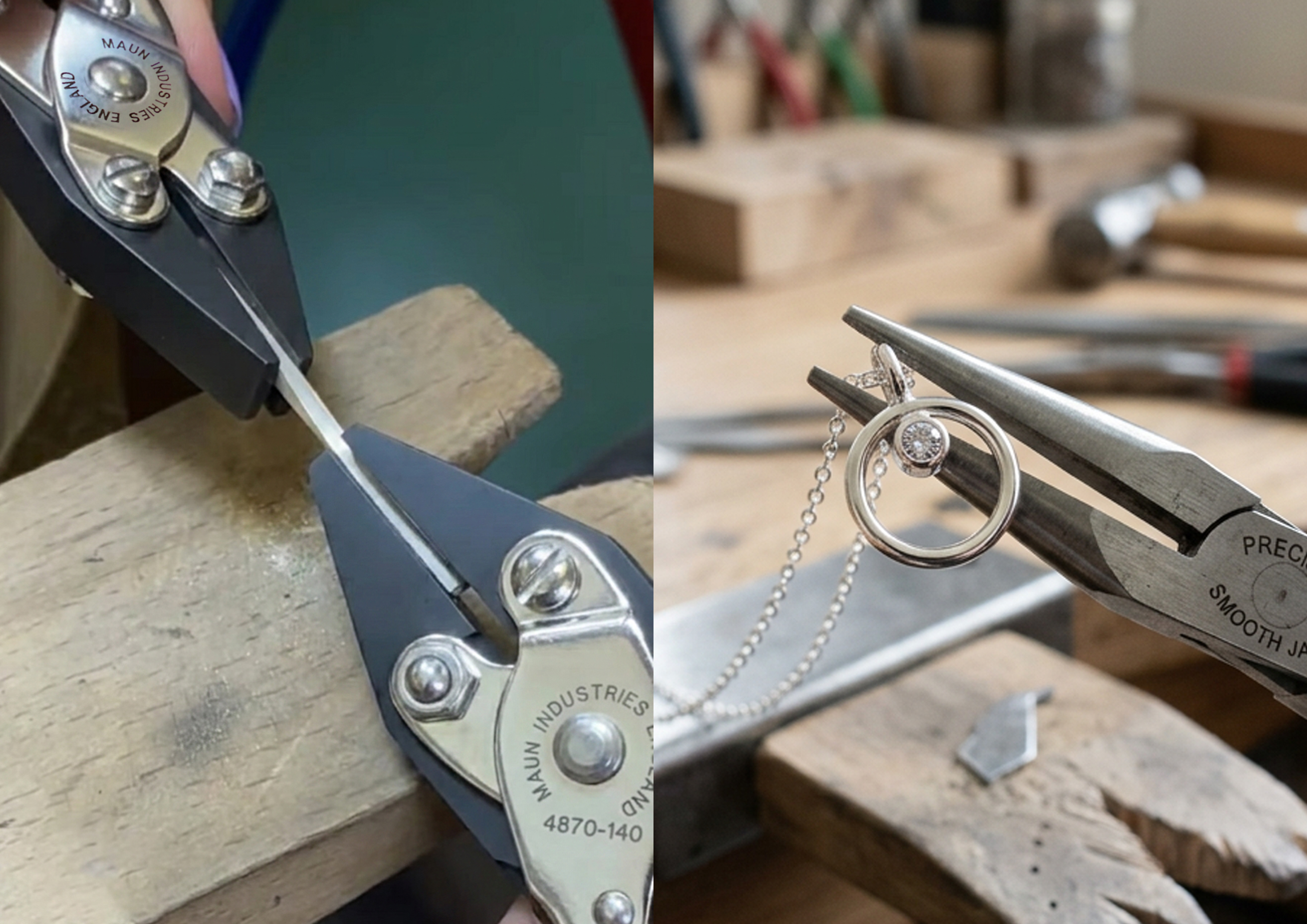
Piers Carpenter, a goldsmith and the winner of series two of the BBC’s All That Glitters, road-tested the difference between parallel-action and pivot-action pliers on camera: a wire held across ordinary pliers gives only about 6.5 mm of jaw contact, while the same wire along a parallel jaw is gripped for a full 56 mm. That even, full-length hold is why the parallel-action version of a plier is the better choice for almost every job at the bench, from bending and holding to straightening and setting.
The only real downside to parallel-action pliers is they are more expensive than pivot-action, but if you care about the quality of your jewellery (e.g. if you plan to sell them), then it’s usually worth upgrading to the better tool when you can.
Some people advise against parallel-pliers unless you are doing specialist work, but this is factually inaccurate and usually comes from businesses selling pivot-action pliers, or from people with less experience making jewellery.
Parallel pliers improve the quality of your jewellery work by improving your accuracy, as well as saving your hand strength so you can work at a higher level for longer per session at the bench.
If you’re interested in upgrading, you can view Maun parallel-action jewellery pliers here.
What is the difference between parallel and pivot pliers?
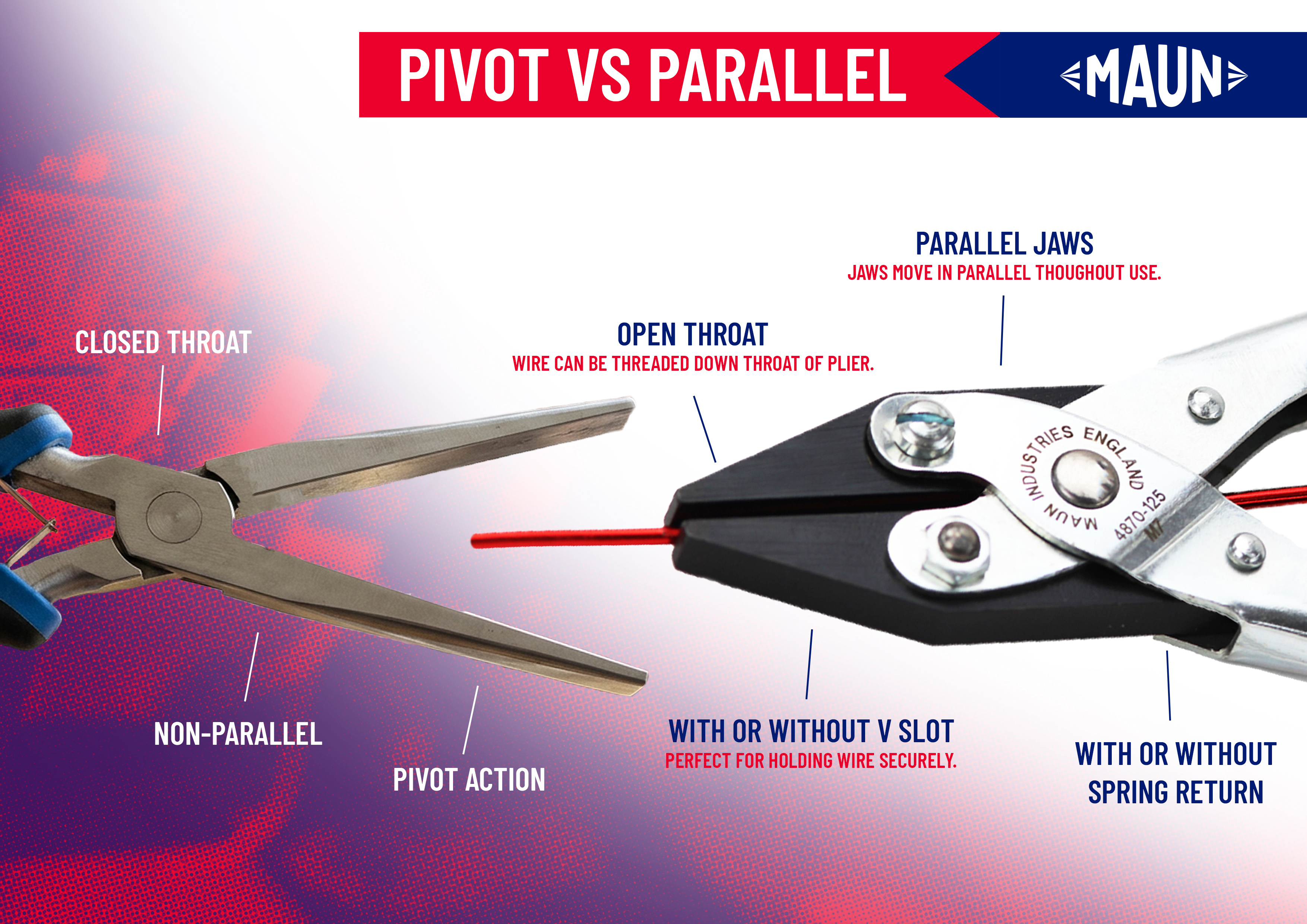
The key difference between these two types of pliers is how the jaws open/close:
- Parallel jaws stay parallel (consistently facing each other) throughout the full opening and closing action.
- Pivot jaws open and close like scissors do (apart from their jaws don’t crossover), so the gap between the jaws when open is larger at the tips than at the base of the pivot.
“Pivot pliers” is not a formal category; it refers to the ordinary single-joint pliers most people already own. Their jaws pivot on a single fulcrum, like a pair of scissors, so the tips move in an arc. As a result, they contact the workpiece over only a small area, creating pressure points that can mark or dent soft metal wire. This limited contact also makes it easier for the workpiece to twist or pivot out of the jaws during filing or when forming tight bends.
Parallel pliers work from a box joint instead. The jaws travel straight towards each other and stay parallel the whole way, meeting as a full flat plane rather than a point. This increases the contact area with your workpiece, improving grip by increasing friction while distributing pressure over a larger surface. The result is greater control and accuracy without crushing or marking the metal, allowing you to manoeuvre the workpiece with more confidence and dexterity. This not only helps protect delicate materials but also enables you to produce higher-quality, more refined, and more creative jewellery.
Want to learn more? Read our guide on how parallel pliers work.
Why do my pliers leave marks on the metal?
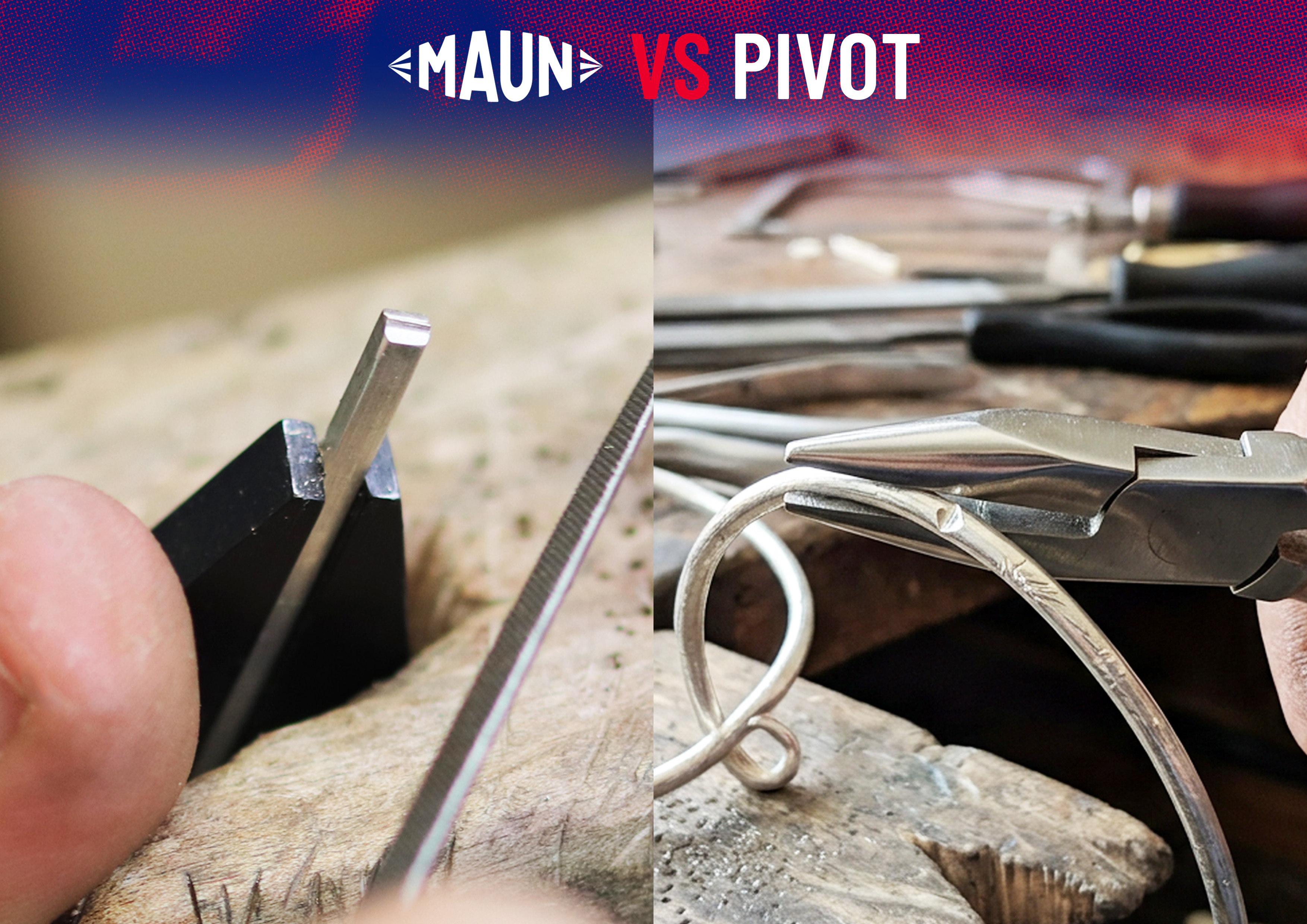
Pliers usually leave a mark on metal wire if they have serrated jaws (that indent the wire), or they have a pivot-action that has created a pinch point on the wire.
The best way to avoid this is to use smooth jaw parallel-action pliers for your jewellery work, as the smooth jaws prevent indentation on the soft wire, and the parallel-action means the gripping force is distributed more evenly over the workpiece, reducing any single pinch point you get with pivot-action pliers.
In some cases when using very soft metal wire, even smooth jaw pliers can mark the metal, so in those situations you should use nylon jaw pliers.
It’s worth remembering that every mark left on precious metal costs a jeweller money. A dent in sterling silver or gold means material must be filed away and the surface re-polished, wasting both metal and time. This is why jeweller Piers Carpenter, who works in 18ct gold and silver every day, described switching to nylon-jawed parallel pliers as “almost revolutionary.” As he explains, “wastage is a big thing for us,” and using pliers that don't mark the workpiece eliminates the filing and re-polishing that dents inevitably require.
See Maun’s nylon-jaw parallel pliers for more details.
Which plier does which jewellery job?
For almost every job in jewellery making, parallel-action pliers are better than pivot-action pliers. Here is a breakdown of each benefit per jewellery task:
|
Task |
Better choice |
Why (from the bench) |
|
Turning loops and curves |
Parallel round-nose |
Even grip on soft wire forms the loop without denting it as you wrap |
|
Sharp right-angle bends |
Parallel flat-nose |
Untapered jaws hold the whole face square, so you can see and fix a true 90 degrees where tapered jaws let the ring drift wibbly wobbly |
|
Bending a wide ring shank |
Parallel half-round-and-flat |
Full-width contact stops the middle bowing; ordinary half-rounds open into a V and bend only from the bottom, so you file the bow off afterwards |
|
Forming and closing jump rings |
Parallel round-and-flat |
The flat face avoids the divot that round-on-round pliers press into round wire; a slight flat is far easier to true back to round than a divot |
|
Holding a stone setting to cut a daylight |
Parallel round-and-flat |
The round jaw supports the setting from inside so grip does not crush it; one BCU bench jeweller calls this her most-used pair |
|
Filing a flush top on a wire |
Parallel V-notch |
Grips the wire on three sides so it cannot skid, and you file down to the jaw for a guaranteed-flush top; the plier becomes your clamp |
|
Straightening wire |
Parallel nylon-jaw |
Draw the wire through the flat jaws; even pressure takes out kinks without leaving a mark |
|
Reaching the tightest settings |
Fine or thin parallel jaw |
Thin parallel jaws hold work under 3 mm wide and fold a truer 90 degrees than a tapered snipe you have to tilt |
If you want more information, our guide to jewellery-making pliers covers each sub-type of jewellery pliers in more detail.
Can parallel pliers do fine, detailed work?
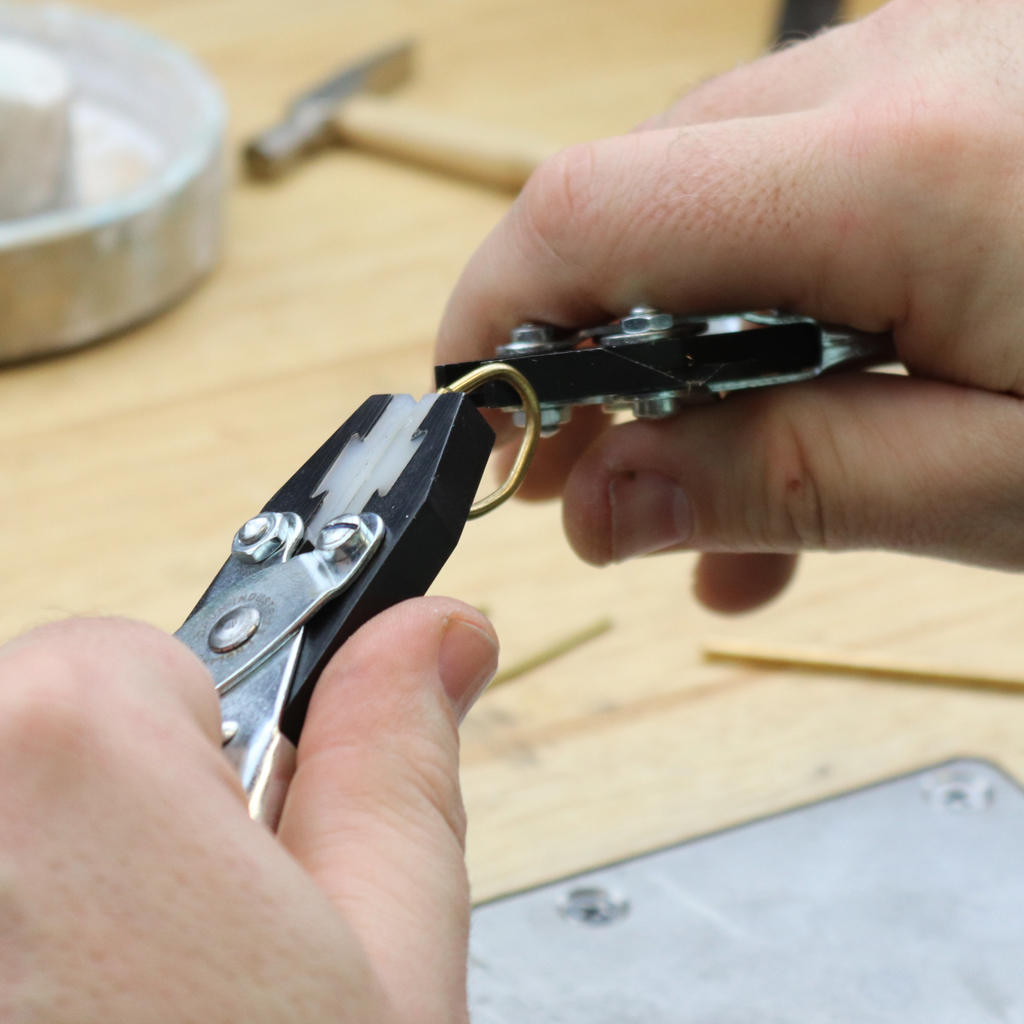
Yes, and the old idea that parallel pliers are too chunky for fine work is out of date. Maun’s thin-jaw parallel plier holds a piece just under 3 mm wide, and because its jaws are fine and untapered it folds a truer 90 degree angle than a standard snipe nose pair, which is tapered and has to be tilted to reach square. For small loops and links, a fine parallel round or snipe nose reaches most tight spots while still gripping the whole face – gaining the benefit of parallel-action over pivot-action for even grip and less marking/crushing.
A note on return springs: a return spring speeds up repetitive cutting, but it fights the small, controlled work that picking up and setting tiny parts need, which is why many jewellers pop the spring out of their fine pliers. The one place a slim tapered pivot tip still has an edge is pure bulk at the very tightest reach, and even there a thin parallel jaw closes most of the gap while holding more gently.
Do you need parallel pliers, or will pivot pliers do?
If you don’t care much about the end quality of your jewellery, and you’re not aspiring to make jewellery for a living, then you can do without parallel-action pliers.
But if you want to produce high-quality jewellery for sale/own wear, or you want to learn the tools that the pros use so you’re ready to work when you’ve finished training, parallel-action pliers are best.
If you are building a kit, buy the parallel-action version of each shape you need rather than a cheap pivot set that you’ll end up replacing anyway: you will mark less metal, waste less silver, and hold everything more securely.
For sheet and bezel work, rings, cuffs and wider stock, they are close to essential, since that is where even holding and a true square decide the finish.
Maun has made parallel pliers in England since 1944, hardens its smooth jaws to 57 HRc, and develops its specialist jaws, the V-notch, the two-step curved edge and the soft nylon jaws, with the School of Jewellery at Birmingham City University. Professionals like Piers Carpenter reach for the standard snipe nose pliers every day; it is the one plier he says he would keep over all his others. You can browse the full range of Maun jewellery pliers here, all made in England.
FAQs
What are the best pliers for jewellery making?
We recommend one pair of parallel-action snipe nose pliers, one pair of round nose parallel pliers and one pair of flat nose parallel pliers. We also recommend a pair of side cutters for working with wire.
After that, you can add nylon jaw pliers and a V-notch plier as your work requires.
We compare our top choices in this post.
Are nylon-jaw pliers better for soft metal?
Yes, nylon-jaw pliers are usually best when working with very soft metals, as the nylon jaws do not bite into polished silver or gold. They are slightly less secure in their grip because of this, so they suit delicate handling rather than heavy forming.
Do parallel pliers come in different jaw shapes?
Yes, they do: flat-nose, chain-nose, snipe, round-nose, half-round, thin-jaw and V-notch parallel pliers all exist.
Final Summary
For jewellery making, the parallel-action version of a plier is the better choice for almost every task, because the even, full-face grip holds more securely with less effort and will not mark soft, precious metal.
If you have any feedback or improvements you’d recommend for this post, we’d love to hear from you.
This post was brought to you by Maun, experts in tools since 1944.
Scroll back up to re-read any key points, browse our related pages below, or contact us with any questions: