


How to shorten a roller blind chain and make a neat join
Published by Rebekah Jackson, Digital Marketing Executive on 10th Nov 2026
A roller blind chain that hangs too long gets in the way. It drapes over the sill, catches behind furniture and is too long to hold taut with a chain tidy. The fix is to take the extra chain out of the loop and join the two ends again.
To shorten a roller blind chain, work out how much chain the loop needs to reach the chain tidy, cut off the rest, open the end ball on one side, drop the link from the other end into it and close the ball round again. Done properly, the join looks and runs like any other ball on the chain.
Closing the ball neatly is the tricky part. Ordinary pliers can deform it, leaving a join that may loosen with use. The Maun Ball Chain Plier was developed at the request of the window blind industry to solve this problem.
Before You Start: Keep the Chain Safe
Shortening a blind chain is a chance to make it safer, never a reason to take a safety device off. Looped blind chains are a strangulation risk to young children, and since 2014 every internal blind sold in the UK has had to meet the child safety requirements of BS EN 13120:2009+A1:2014. It is illegal to supply or professionally install an internal blind that doesn't comply, according to the British Blind and Shutter Association's Make it Safe guidance.
Check which safety device your blind uses before you cut anything:
- A chain tidy or tensioner. This is fixed to the wall or window frame and holds the loop permanently taut. The BBSA says it should be fixed as far from the top of the blind as the chain allows, and blind makers' instructions typically put it at least 1.5 m from the floor. A shorter loop usually means moving the tidy up as well, so plan both together.
- A chain-break connector. This clips the chain together and parts under load, then clips back after you've checked it. Never replace a chain-break connector with a permanent ball join. If your chain has one, keep it, and use the connector designed for your chain.
Fitters will already be working to this. At home, follow the blind maker's instructions, and the BBSA's Make it Safe site has more help.
How Much Chain Should You Take Off?
Take off enough for the loop to sit taut round the chain tidy, and no more. Roller blind chain runs round the control unit as a continuous loop, so shortening it doesn't change how far the blind goes up or down. It only changes where the bottom of the loop hangs.
- Decide where the tidy goes. Mark its position on the wall or frame, as far from the top of the blind as you can, following the blind maker's minimum height.
- Pull the loop down to the mark. Hold both strands together just above the mark, with the chain taut.
- Mark both strands. Mark the ball on each strand level with your fingers. The U of chain hanging below the two marks is the spare.
- Cut long, not short. Leave a couple of balls more than you think you need. You can always take more off, but you can't put chain back without a connector.
How to Shorten a Roller Blind Chain, Step by Step
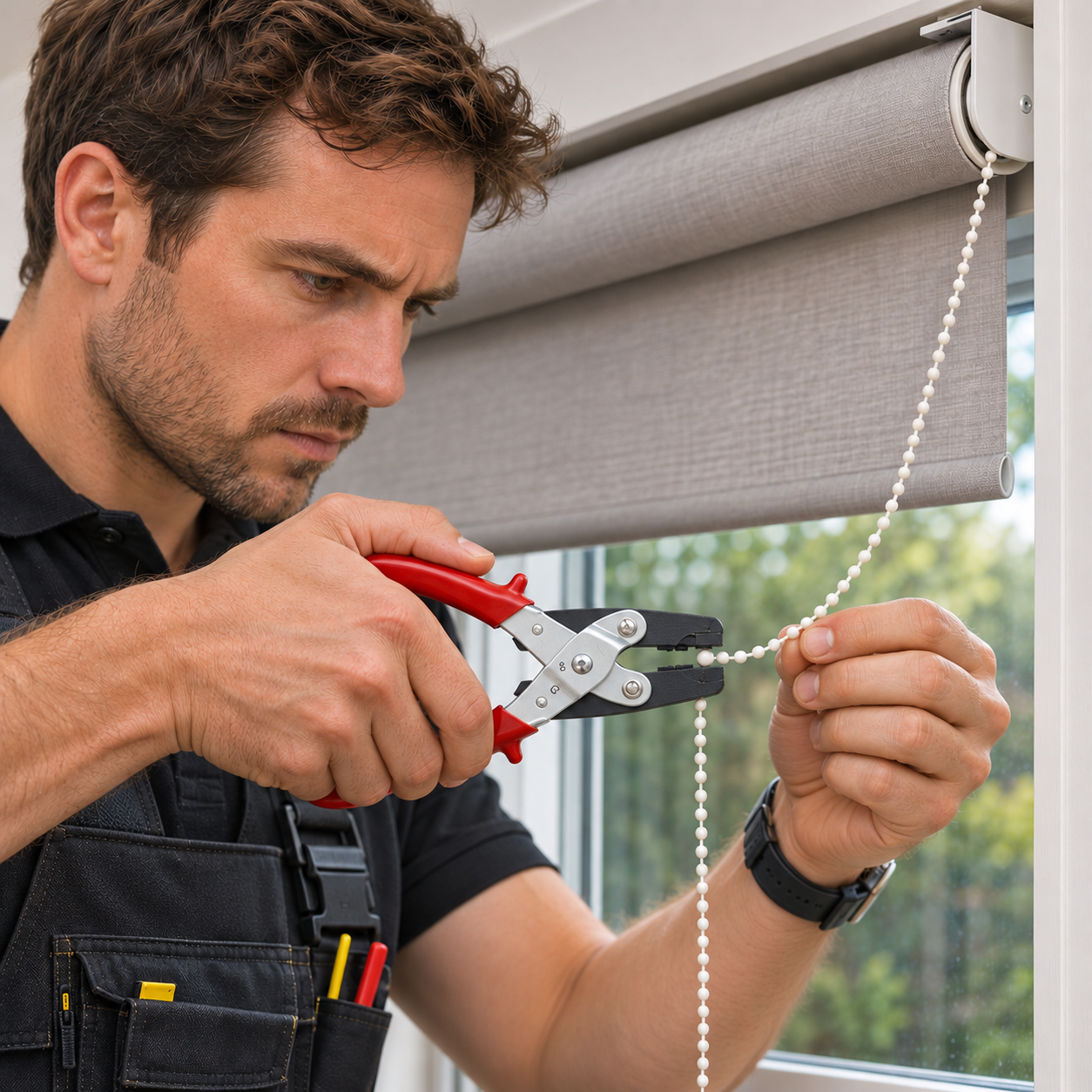
These steps are for a loop joined with a permanent ball join. If your chain has a chain-break connector, or the blind maker's instructions call for one, keep it and don't replace it with a ball join.
The join itself is simple once you can picture it: one free end finishes in a bare link, the other in an opened ball, and the link goes into the ball before the ball is closed round it.
Before you start, unhook the chain from its chain tidy. You need the Maun Ball Chain Plier in the size that matches your chain (see the next section) and a pen or a strip of tape to mark the chain.
- Make two cuts, one at each mark. Use the integrated cutter on the plier to cut through the link just below each mark. The U of spare chain comes away, and the loop is now one length of chain with two free ends.
- Expose a link on one end. To join the chain, you need a closed ball on one end and a bare link on the other. If both ends finish in a ball, set one end ball against the precision pin and squeeze until the ball comes away, leaving the link showing.
- Open the ball on the other end. Set the end ball against the precision pin and squeeze gently, just until a gap opens in the ball. Stop there. An over-opened ball is harder to close round.
- Seat the ball in the concave dies. Move the opened ball into the shaped dies in the plier's jaws.
- Drop the link into the ball. Feed the bare link from the other end into the opened ball, checking the chain isn't twisted round the loop.
- Close the ball. Squeeze firmly. The parallel jaws bring the concave dies together evenly, closing the ball round the link.
- Check the join. Pull either side of the join firmly, then run the join through your fingers. It should feel like any other ball on the chain.
- Refit the chain and the tidy. Put the loop back over the control unit, fit the chain tidy at the mark and check the loop sits taut. Run the blind up and down a few times and watch the join go through the control unit.
Watch our How To Video on YouTube HERE.
There's more on each stage of the plier itself in our guide on how to use metal ball chain pliers.
Which Size Ball Chain Is on Your Blind?
Measure the diameter of one ball before you buy a plier, because each Maun Ball Chain Plier fits one ball size. Use a digital calliper across the widest part of a ball. No.10 (4.5 mm) is the most popular size and suits a lot of roller blind chain, but vertical blind chain can be smaller, so check yours.
|
Ball diameter |
Chain size |
Maun plier |
|
3.2 mm |
No.6 |
|
|
4.0 mm |
No.8 |
|
|
4.5 mm |
No.10 |
|
|
6.3 mm |
No.13 |
All four are 170 mm long. If your ball measures 2.4 mm (No.3), as on some light pulls, none of the four will fit.
Why Ordinary Pliers Can Damage the Join, and How the Maun Plier Helps
Insert image of the jaws of the Maun Ball Chain Plier, close up, showing the precision pin and concave dies, with the Maun name visible
Ball chain can be rejoined using ordinary pliers or a clip-on joiner. Both can work, but each has a weak spot, and the Maun Ball Chain Plier is designed around them.
|
The usual problem |
How the Maun plier deals with it |
|
Ordinary pliers close at an angle, so they can squash the ball out of round. An oval ball grips the link at two points, and the join may loosen with use. |
Parallel jaws and concave dies close the ball evenly from every side, so it grips the link all the way round. |
|
A squashed ball or a clip-on joiner is a different size from the rest of the chain, so it can snag in the control unit. |
The closed ball comes back the same size as the others and runs through the control unit with the rest of the chain. |
|
Ordinary pliers need a separate cutter, and they can't open a ball cleanly. |
The cutter, precision pin and dies are built into one plier, which matters when you're up a ladder. |
|
Many marketplace chain tools fit No.10 (4.5 mm) chain only. |
Four sizes, from No.6 (3.2 mm) to No.13 (6.3 mm). |
The handles multiply your hand force by 5, so closing a ball takes little force. The jaws are hardened to HRC 57, which helps the dies keep their shape with regular use.
The Maun Ball Chain Plier costs more than a marketplace chain tool, so it earns its place when you join chains regularly. That makes it a fit for blind fitters, hotel and property maintenance teams, and workshops that make chains to length. It's made in Nottinghamshire, England, and carries a 12-month warranty, extended to 24 months when you register the tool.
Shortening blind chains regularly? The Maun Ball Chain Plier cuts, opens and rejoins metal ball chain in one tool, in four sizes from 3.2 mm to 6.3 mm. Find the right plier for your chain.
When the Maun Ball Chain Plier Isn't the Right Tool
The Maun Ball Chain Plier is made for metal ball chain from 3.2 to 6.3 mm. It isn't the right tool for:
- Plastic bead cord. Plastic chain can't be reformed. Join it with the connector made for it.
- Balls under 3.2 mm or over 6.3 mm. Including the 2.4 mm (No.3) chain on some light pulls.
- The odd household repair. If you only have one blind chain to shorten, a cheaper single-size tool may be enough.
FAQs
Does shortening a blind chain change how far the blind goes down?
No. Roller blind chain runs round the control unit as a continuous loop, so a shorter loop only changes where the bottom of the chain hangs. The blind still travels its full drop.
Can you shorten a blind chain without special pliers?
Yes, with side cutters and a clip-on joiner, but the joiner is bulkier than a ball and can catch in the control unit. Ordinary pliers can deform the ball if you try to rejoin it. A ball chain plier opens and closes the chain's own ball instead.
Why does my blind chain keep coming apart at the same place?
Check first whether it's a chain-break connector. That's a safety device doing its job: inspect it and clip it back together. If it's a ball join that keeps letting go, the ball may have been closed out of round. Cut it out and rejoin the chain with a ball chain plier in the right size.
Can I take the safety connector off when I shorten the chain?
No. A chain-break connector or chain tidy is there to stop the loop becoming a strangulation risk to young children. Shorten the chain and keep the safety device in place.
Final Summary
Most of the work in shortening a roller blind chain is in the planning. Decide where the chain tidy goes and the length of the loop follows from it. After that it's two cuts and one join, then a few runs of the blind up and down before you leave it.
If you shorten blind chains often, it's worth having a Maun Ball Chain Plier in your chain's size. Done right, first time.
If you have any feedback or improvements you'd recommend for this post, we'd love to hear from you.
This post was brought to you by Maun, specialist plier makers since 1944.
Scroll back up to re-read any key points, browse our related pages below or contact us with any questions:
Ball Chain Plier No. 10 4.5 mm
How to Use Metal Ball Chain Pliers
About the author
Rebekah Jackson is Digital Marketing Executive at Maun Industries, the family-owned toolmaker that has made pliers and hand tools in Nottinghamshire, England, since 1944. She joined Maun in 2015 and has worked across all aspects of the business since, including assembling tools in the factory, which is why her guides start from the jobs people use Maun tools for. She writes Maun's knowledge-based guides, with every specification checked against Maun's published product data.
Published: 10.11.2026 · Last updated: 10.11.2026