



How to cut music wire and piano wire cleanly by hand
Published by Rebekah Jackson, Digital Marketing Executive on 19th Nov 2026
Cutting music wire can be frustrating. It’s tough and springy, and it can ruin ordinary wire cutters, leaving you with a rough end or a notched cutting edge.
Music wire, also called piano wire, is used for everything from piano strings and springs to model pushrods. This guide explains which cutter to use for different wire sizes, how to make a clean cut and how to finish the end.
The short answer: use a cutter rated for your wire’s diameter, cut in one firm squeeze, then file the end smooth. For music wire up to 2.0 mm, that’s Maun’s Diagonal Cutting Plier For Hard Wire 160 mm. Its compound-lever action multiplies the force you put through the handles, so tough piano wire cuts cleanly without straining your hand.
Why Music Wire Ruins Ordinary Cutters
Music wire is cold-drawn high-carbon spring steel, commonly supplied to specifications such as ASTM A228/A228M or BS EN 10270-1. This is generally recognised as the highest tensile strength wire in common use.
That strength is what suits it to piano strings, springs and pushrods. It’s also why ordinary wire cutters often struggle:
- The blade can notch. An ordinary diagonal cutter is made for copper and soft steel. Try cutting 1.5 mm music wire with an ordinary cutter, and you risk denting the cutting edge. If that happens, every soft wire you cut through the notch afterwards leaves a tag.
- It can crush instead of cut. A damaged edge can start squashing the wire rather than cutting it, leaving a flattened end that won’t thread through a tuning pin, a connector or a spring eye.
- It takes too much effort. A small, single-pivot cutter may not put enough force on hard wire, so you can end up squeezing with both hands or twisting the wire off, which can kink the wire you’ve just measured.
The Maun Diagonal Cutting Plier is built for this job:
- Less effort per cut. The compound-lever action multiplies the force you put through the handles: 18 times on the 140 mm and 22 times on the 160 mm. The extra leverage makes cutting hard wire easier, reducing the effort needed for each cut.
- Hardened cutting edges. Induction-hardened to HRC 64, the cutting edges resist damage when cutting tough piano wire, helping them stay sharp for longer.
- Published capacities. Maun publishes what each size cuts in piano, hard and soft wire, so you can check it suits your wire.
- Return spring. It opens the jaws between cuts, which speeds up repeat work.
Our cutting pliers are made in Nottinghamshire, England, where Maun has manufactured pliers and cutters since 1944. It’s not uncommon to find Maun cutters still in use after 20 years and more.
Which Cutter Do You Need for Your Wire Size?
Match the cutter to the thickest music wire you’ll cut. Wire is often sold in inch sizes or by gauge number, so we’ve added the metric equivalent. Measure your wire with a micrometer or calipers if you’re not sure.
|
Music-wire size |
Metric |
Maun cutter |
|
1/32 in |
0.8 mm |
Diagonal Cutting Plier 140 mm or 160 mm |
|
3/64 in |
1.2 mm |
Diagonal Cutting Plier 140 mm or 160 mm |
|
1/16 in |
1.6 mm |
Diagonal Cutting Plier 140 mm (at its limit) or 160 mm |
|
5/64 in |
2.0 mm |
Diagonal Cutting Plier 160 mm (at its limit) |
|
3/32 in |
2.4 mm |
Side Cutter Parallel Plier 200 mm |
The published capacities for each cutter, by wire type:
|
Maun cutter |
Piano wire |
Hard wire |
Soft wire |
Hand force |
|
1.6 mm |
2.0 mm |
3.0 mm |
×18 |
|
|
2.0 mm |
2.5 mm |
4.0 mm |
×22 |
|
|
2.5 mm |
3.0 mm |
6.0 mm |
×25 |
Each cutter cuts wire up to its published capacity. If you regularly cut wire at the maximum rated diameter, choosing the next cutter size up can reduce the effort needed. If you cut music wire all day, as a piano technician or a spring maker might, there’s a comfort-grip version of each Diagonal Cutting Plier too.
How to Cut Music Wire, Step by Step
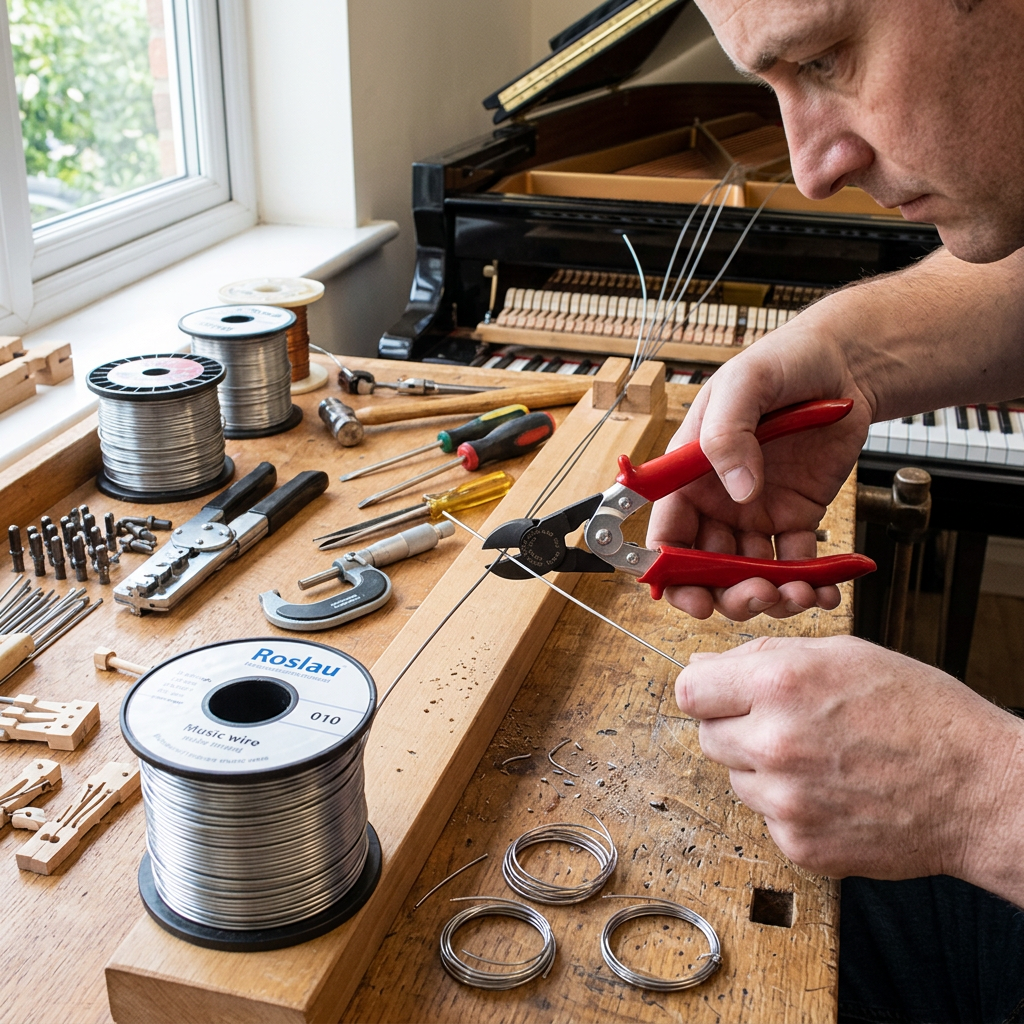
You need the right cutter for your wire size (see the table above), safety glasses, a rule, a fine marker and a fine flat file.
- Put your safety glasses on. Music wire is springy, and the offcut can fly when the cut breaks through. This matters more with music wire than with soft wire.
- Measure and mark the length. Measure from your plan, the old string or spring, or the job itself, and allow for any bends or coils you’ll form. If you’re not sure, cut it long: you can take more off, but you can’t put it back.
- Set the wire deep in the jaws. Place it in the cutting edges close to the joint, not at the tips. That’s where the cutter has the most leverage, so the cut needs the least effort and the edge is under the least strain.
- Keep the wire square to the blades. Hold it at 90° to the jaws. An angled cut leaves a longer, sharper point and loads the edge unevenly.
- Contain the offcut. Music wire can spring away when cut. Cover the jaws and short end with a cloth, or cut inside a suitable container to catch flying pieces. Keep your fingers clear of the cutting area and point the offcut away from yourself and others.
- Cut in one firm squeeze. Close the handles steadily until the wire parts. Don’t rock, twist or lever the cutter to finish the cut, as this can kink the wire or damage the cutting edges.
- Dress the end. The wedge-and-indent cut leaves a slight point. Square it off with a few strokes of a fine file, then take off any burr.
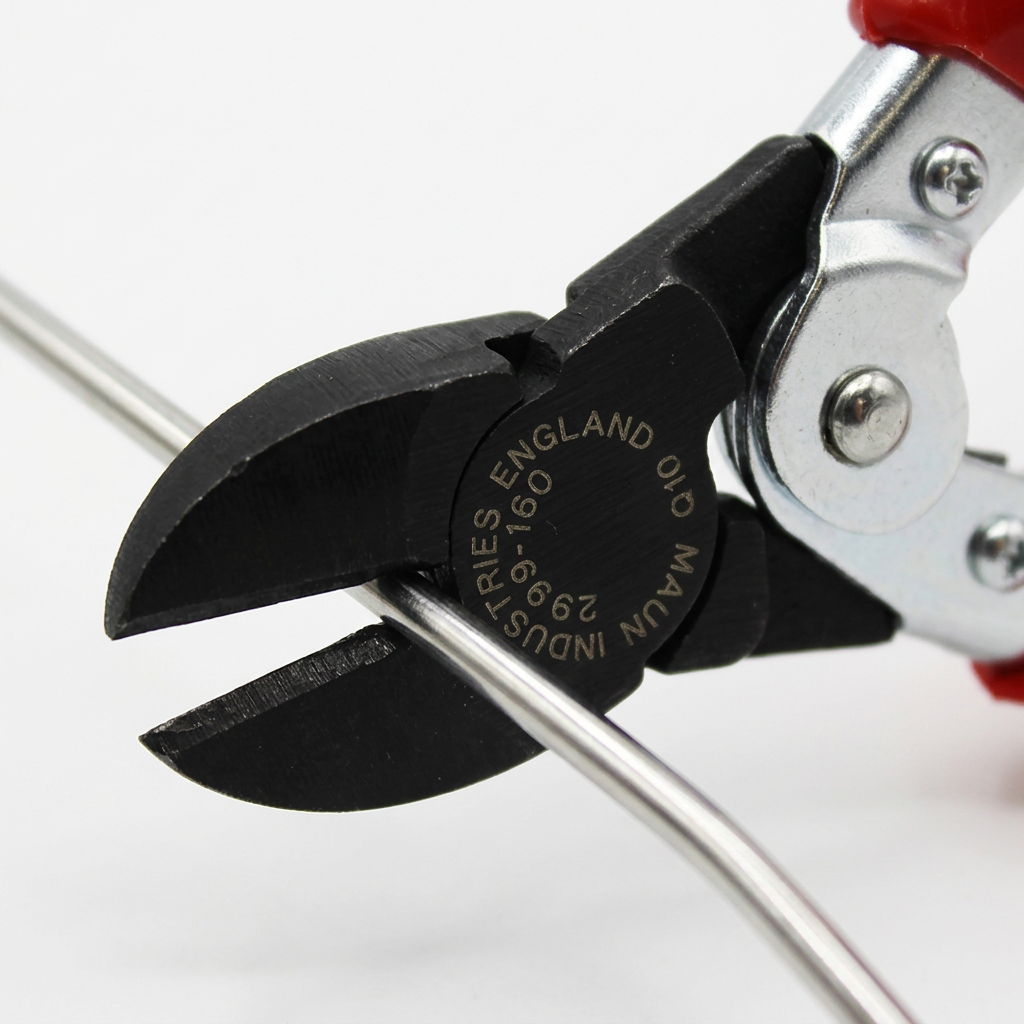
Insert image (priority 3): close-up of a cut music-wire end before and after filing, side by side, with a rule for scale
If you’re cutting several pieces to the same length, cut one, check it, then use it as the pattern for the rest.
Tips for Common Music-Wire Jobs
Piano strings
When a plain string breaks, the new length is cut from a coil of piano wire. Match the new wire to the old string’s diameter, and keep a firm hold on the coil while you cut, so it can’t spring open across the bench. Plain piano strings are usually sizes 12 to 22, from about 0.74 mm to just over 1.2 mm in diameter, with the heaviest plain wire up to 1.6 mm. That’s within the piano-wire capacity of both Diagonal Cutting Pliers: the 140 mm cuts up to 1.6 mm, and the 160 mm up to 2.0 mm, which leaves headroom for the heavier strings.
Springs
Cut spring wire to length before you coil it, and check its diameter against the cutter’s piano-wire capacity first. Hold the wire firmly so the free end can’t whip as the cut breaks through, and keep your face out of line with the cut.
Model pushrods and control rods
Pushrods often need a Z-bend or an L-bend at the servo or horn end. Ordinary single-pivot pliers grip most firmly near the joint, which can make springy wire difficult to hold securely at the tips.
Use a parallel-action plier instead: its jaws stay parallel and grip along their whole length. The Side Cutter Parallel Plier grips, bends and cuts in one tool, though its serrated jaws mark the wire. For a crisp, unmarked bend, use a Flat Nose Parallel Plier. Form the bend at one end first, then measure and cut the other end to length.
Our Recommended Cutter for Music Wire
For most music-wire and piano-wire work, choose the Maun Diagonal Cutting Plier For Hard Wire 160 mm. It cuts piano wire up to 2.0 mm, and its compound-lever action does the hard work, so you can cut with less hand effort. It suits piano technicians, spring makers, model makers, engineers and anyone who cuts hard wire regularly.
See the Maun Diagonal Cutting Plier For Hard Wire 160 mm
When the Diagonal Cutting Plier Isn’t the Right Tool
The Diagonal Cutting Plier is made for hard and piano wire within its published capacity. There are some jobs where a different cutter is more suitable:
- Music wire thicker than 2.0 mm. Don’t force it through the 160 mm: over-capacity cuts are what chip a hardened edge. Use the Side Cutter Parallel Plier 200 mm up to 2.5 mm piano wire, and a bolt cutter or an abrasive cut-off wheel above that.
- Multi-strand cable and control cable. Wedge-and-indent jaws splay the strands. Use a cable cutter that shears.
- Wire you also need to grip or bend. The Diagonal Cutting Plier only cuts. If you want one tool that grips, bends and cuts, use the Side Cutter Parallel Plier.
- Thin sheet, film and fabric. The edges are ground for hard wire, not sharpened like a knife, so they won’t cut wide, thin material cleanly.
- Live electrical work. The standard model has no insulation rating. Near live parts, use the 1000V Insulated Diagonal Cutting Plier, made to IEC 60900:2018.
FAQs
Is music wire the same as piano wire?
Yes. Music wire and piano wire are two names for the same high-carbon spring-steel wire, commonly supplied to specifications such as ASTM A228/A228M or BS EN 10270-1. Modellers usually say music wire; piano technicians and tool makers usually say piano wire.
Can you cut music wire with ordinary side cutters?
Thin music wire, perhaps, but you risk notching the edge. Use a cutter that publishes a piano-wire capacity, and stay within it.
Why does the cut end have a point?
A diagonal cutter presses into the wire from both sides and parts it, so each end finishes in a slight point. That’s normal: a few strokes with a fine file squares it off.
Final Summary
Cutting music wire cleanly starts with choosing a cutter rated for the wire’s diameter. Position the wire correctly, make one firm cut and file the end smooth. For piano strings, springs and model pushrods alike, the right technique makes the job easier and helps protect your tools. Done right, first time.
If you have any feedback or improvements you’d recommend for this post, we’d love to hear from you.
This post was brought to you by Maun, specialist plier makers since 1944.
Scroll back up to re-read any key points, browse our related pages below or contact us with any questions:
Diagonal Cutting Plier For Hard Wire 160 mm
Diagonal Cutting Plier For Hard Wire 140 mm
About the author
Rebekah Jackson is Digital Marketing Executive at Maun Industries, the family-owned toolmaker that has made pliers and hand tools in Nottinghamshire, England, since 1944. She joined Maun in 2015 and has worked across all aspects of the business since, including assembling tools in the factory, which is why her guides start from the jobs people actually use Maun tools for. She writes Maun’s knowledge-base guides, with every specification checked against Maun’s published product data.
Published: 12.11.26 · Last updated: 12.11.26