


How to punch an extra hole in a belt
Published by Rebekah Jackson, Digital Marketing Executive on 29th Oct 2026
Belts don’t always fit the way they did when you bought them. Weight changes, the clothes you wear with a belt change, and sometimes the right fit simply falls between two holes. The fix is one more hole, and it isn’t difficult to add, but it has to match the others: the same size, on the same centre line, at the same spacing, and cut cleanly so it doesn’t stretch or tear under the pull of the buckle.
To punch an extra hole in a belt, measure the spacing between the existing holes, mark the new hole on the centre line at the same spacing, select the punch that matches the other holes, and cut it in one firm squeeze with a revolving punch plier.
That last step is where belts get difficult. Belt leather is usually about 3.5 mm thick, and on leather that thick a standard revolving punch plier takes your full hand force, especially over more than one hole. Maun’s Heavy Duty Revolving Leather Hole Punch Plier is designed for exactly that job, with compound-lever action that takes up to 70% less effort than a standard revolving punch plier. There’s more on choosing between the two below.
Where Should the New Hole Go?
Put the new hole where the belt fastens comfortably, in line with the others and at the same spacing. Wear the belt with the clothes you usually wear it with, pull it to a comfortable fit and note where the buckle tongue meets the strap. Most of the time, one extra hole at the belt’s usual spacing gives you the fit you need.
Keep the new hole on the plain part of the strap, clear of stitching, rivets and tooled or decorated areas, which a punch can damage. And if you find yourself adding a second or third hole at the same end, check the tail: a belt that fastens near its middle hole, with the tail reaching past the first belt loop, sits and looks right.
What You Need to Add a Hole to a Belt
You need three things: a revolving punch plier, a rule or tape measure, and a pen, pencil or awl to mark the hole. If you have an offcut of similar leather, a test hole on it first shows you how much pressure the punch needs.
How to Punch an Extra Hole in a Belt, Step by Step
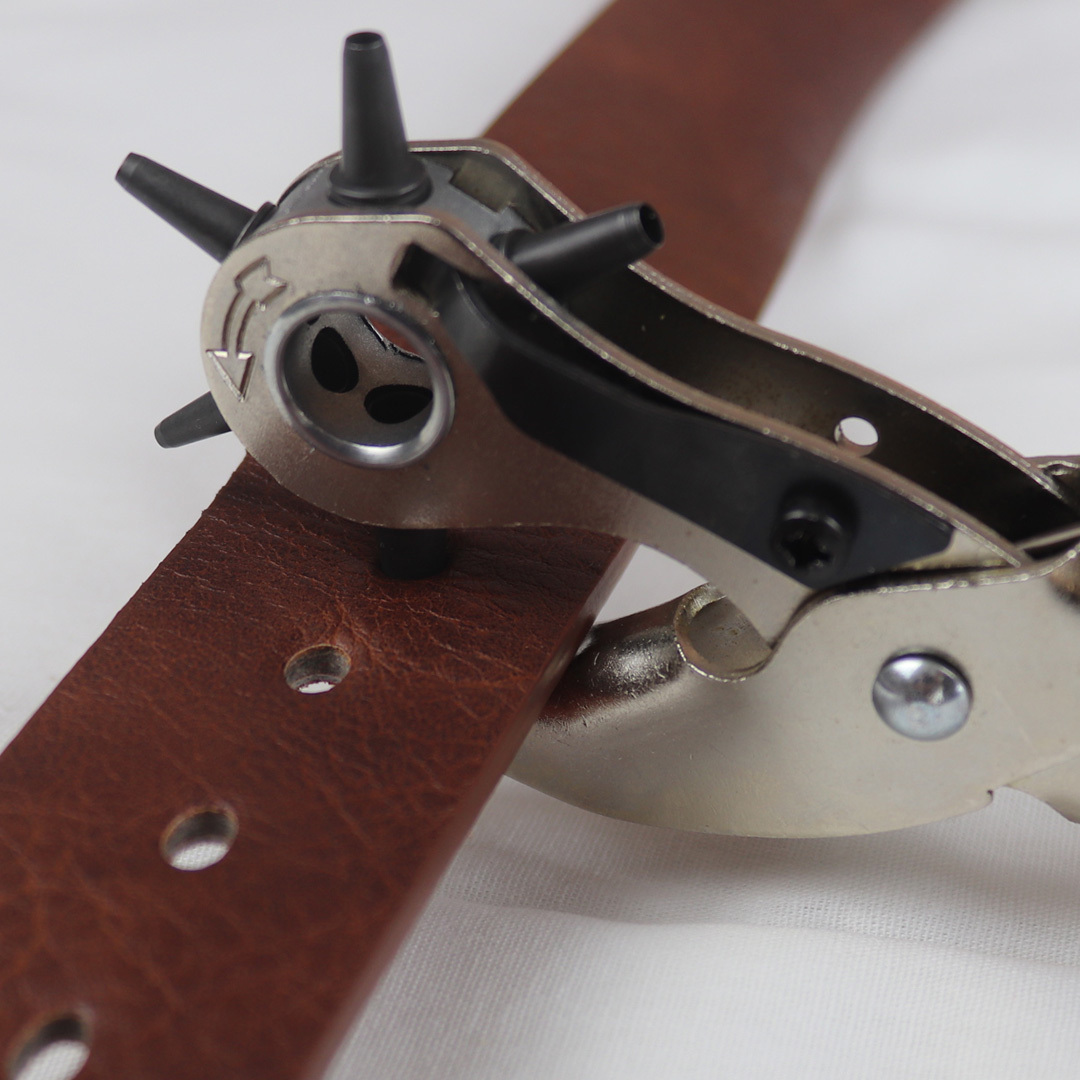
- Measure the spacing between the existing holes. Measure centre to centre between two neighbouring holes. The new hole goes the same distance from the last one, so the row stays even.
- Match the hole size. Compare the existing holes with the punches on the drum and find the one that matches. If a hole sits between two sizes, choose the smaller: you can open a hole up, but you can’t make it smaller.
- Mark the new hole. Mark the centre on the front of the belt, on the centre line, with a light pencil mark or an awl prick. The punch removes the mark with the slug of leather.
- Select the punch. Turn the drum until the size you want sits over the anvil, and check it has clicked fully into line. On the Maun Heavy Duty Revolving Leather Hole Punch Plier, a side spring indexes and locks each punch in place, so the tube meets the anvil squarely instead of sitting half on its edge.
- Face the front of the belt to the punch. Slide the belt into the jaws with the front facing the punch tube and the mark under it. Punch from the side that will show, because the exit hole on the other side comes out slightly smaller and rougher.
- Keep it square. Hold the belt square to the jaws before you squeeze, as a tilted punch cuts an oval hole.
- Squeeze in one firm action. On thick leather, Maun customers find that twisting the punch slightly as you squeeze, while keeping it square to the belt, helps the tube cut cleanly instead of tearing.
- Check the hole and clear the slug. Release the handles, check the hole is cut cleanly right through, and remove the small disc of leather from the tube.
Which Punch Size Do You Need for a Belt Hole?
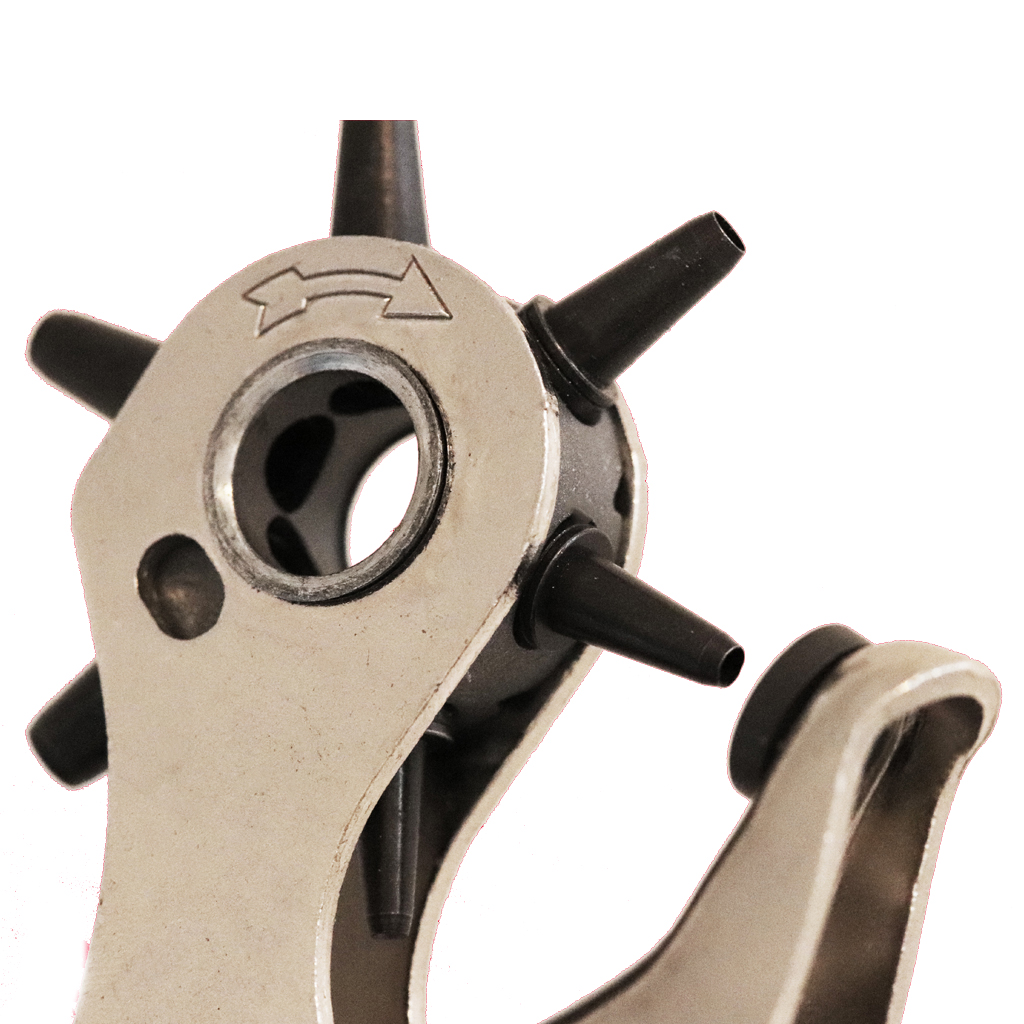
Use the size that matches the holes already in the belt. The six punches on a Maun revolving punch plier cover the usual range of belt adjustment and hardware holes. Buckle-tongue holes are typically around 3.5 to 4 mm, so the 3.2 or 4.0 mm punch is usually the match, but check against your own belt. Larger round holes need a wad punch, and oblong slots need a slot punch.
|
Hole you need |
Tool |
Sizes |
|
Round holes up to 4.8 mm, such as belt adjustment holes |
Revolving punch plier (standard or heavy duty) |
2.0, 2.4, 2.8, 3.2, 4.0 and 4.8 mm |
|
Round holes from 5 mm, such as rivet, stud and eyelet holes |
5 to 32 mm (metric set) or ¼ to 1 inch (imperial set) |
|
|
Oblong slots, such as the slot for a buckle tongue |
Slot punch |
Not covered by a revolving punch or wad punch |
Standard or Heavy Duty Revolving Punch Plier?
For an occasional hole in a thin belt, a standard Maun Revolving Leather Hole Punch Plier is enough. For most leather belts, and for punching a run of holes, the Maun Heavy Duty Revolving Leather Hole Punch Plier is the better tool. Both have six punches from 2.0 to 4.8 mm and lever action. The difference is in how much force they take and how they’re built.
Where a standard revolving punch plier struggles with belts
- Standard belt leather is about 3.5 mm thick (8 to 9 oz). On leather that thick, a standard revolving punch plier takes your full hand force, and over a run of holes the effort shows.
- A standard punch is built for thinner leather, card, canvas, soft plastics and textiles. One Feefo reviewer found Maun’s standard model not strong enough for saddlery work, recommending the heavy-duty model, with its compound-lever action, instead.
- Alignment on cheaper punches. If the drum doesn’t lock squarely over the anvil, the tube strikes the edge of the anvil and rolls its cutting lip, and from then on every hole tears.
How the heavy duty revolving punch plier deals with them
- Compound-lever action. The handles take up to 70% less effort than a standard revolving punch plier, so a 3.5 mm belt punches cleanly without straining your hand.
- Built for leather over 1.5 mm. It’s 260 mm long with a 10 mm jaw opening, and Maun customers use it on stirrup leathers and bridles as well as belts.
- Punches that lock in line. A side spring indexes and locks each punch over the anvil, and a return spring opens the handles after every hole.
- 36 mm of useable jaw depth, which puts the centre line of most belts within reach.
|
|
Heavy Duty Revolving Leather Hole Punch Plier |
Standard Revolving Leather Hole Punch Plier |
|
Best for |
Leather over 1.5 mm: belts, straps, tack and harness |
Thinner leather, card, canvas, soft plastics and textiles |
|
Punches |
Six, 2.0 to 4.8 mm |
Six, 2.0 to 4.8 mm |
|
Action |
Compound-lever action, up to 70% less effort than a standard revolving punch plier |
Lever action |
|
Size |
260 mm long, 10 mm jaw opening, 36 mm useable jaw depth |
200 mm long, 17 mm jaw opening, 35 mm useable jaw depth |
|
Price |
Costs more |
Costs less |
The Maun Heavy Duty Revolving Leather Hole Punch Plier costs more than the standard model, so it’s worth it if you punch belt leather regularly or need more than the odd hole. For an occasional hole in a thin belt, Maun’s standard revolving punch plier does the job.
Both tools are designed by Maun and manufactured to Maun’s design in Germany. In common with all Maun tools, our revolving punch pliers carry a 12-month warranty, extended to 24 months when you register the tool. You can compare both on the revolving punch pliers page.
Punching Holes in Fabric, Webbing and Synthetic Belts
A revolving punch also cuts canvas, soft plastics and textiles, so it will add a hole to many fabric and synthetic belts. Woven webbing can fray around a punched hole, so fit an eyelet to reinforce it. For thick, stiff webbing, test on the end of the belt first, as some weaves are too dense for a hand punch to cut cleanly.
When a Revolving Punch Isn’t the Right Tool
A revolving punch is the right tool for round holes from 2.0 to 4.8 mm within reach of the edge of the belt. It isn’t right for:
- Holes over 4.8 mm. Use a Maun Wad Punch set, which cuts 5 to 32 mm holes using a mallet on a wooden block.
- Oblong belt slots. These need a slot punch.
- Holes a long way in from the edge. A plier punch only reaches as far as its jaws. A drive punch struck with a mallet can go anywhere, though it means a block, a mallet and a separate punch for each size, which is slower over a run of holes and harder to keep in line.
FAQs
How far apart should belt holes be?
Match the spacing of the holes already in the belt. Many belts use 25 mm (1 inch), and some use 19 mm (¾ inch) for finer adjustment. Measure centre to centre between two neighbouring holes and set the new hole the same distance from the last one.
Can you put a hole in a belt without a hole punch?
You can force one with a screwdriver, a heated nail or a drill, but you won’t get a clean hole. These push or tear through the leather instead of cutting it, leaving a ragged edge that can split further under the pull of the buckle. A punch cuts out a round plug of leather, which is why the hole stays round.
Why does my belt punch tear the leather instead of cutting it?
Usually the tube isn’t meeting the anvil squarely, or the leather is too thick for the punch. If the drum isn’t locked, the tube strikes the edge of the anvil and rolls its cutting lip, and after that every hole tears. Check the drum has clicked into place before you squeeze, twist the punch slightly as you close it while keeping it square, and use Maun’s heavy-duty model for leather over 1.5 mm.
Final Summary
That’s how to punch an extra hole in a belt: match the spacing and size of the existing holes, lock the right punch over the anvil, and cut the hole in one firm squeeze.
If you have any feedback or improvements you’d recommend for this post, we’d love to hear from you.
This post was brought to you by Maun, experts in tools since 1944.
Scroll back up to re-read any key points, browse our related pages below or contact us with any questions:
Heavy Duty Revolving Leather Hole Punch Plier
What Is a Wad Punch Tool and How Are They Used?
About the author
Rebekah Jackson is Digital Marketing Executive at Maun Industries, the family-owned toolmaker that has made pliers and hand tools in Sutton in Ashfield, Nottinghamshire, since 1944. She joined Maun in 2015 and has worked across all aspects of the business since, including assembling tools in the warehouse, which is why her guides start from the jobs people actually use Maun tools for. She writes Maun’s knowledge-base guides, with every specification checked against Maun’s published product data.
Published: 29.10.26 · Last updated: 29.10.26